
The exploit vs explore dilemma every marketing team faces
There’s a quiet tension inside almost every marketing team. Should you milk the cow or hunt for a new one?!
Hi dream team,
Been a while. Hope you’re all doing well. Been at my limits with my work and kids but trying to come back to Substack a bit more often now!
This week:
[Feature] Exploit vs Explore
[Video] MLs like teen spirit podcast - about how synthetic control methods (SCM) help marketers estimate causal impact when experiments aren’t possible, and a guide through this powerful practical technique for real-world campaign, retail, and media analysis.
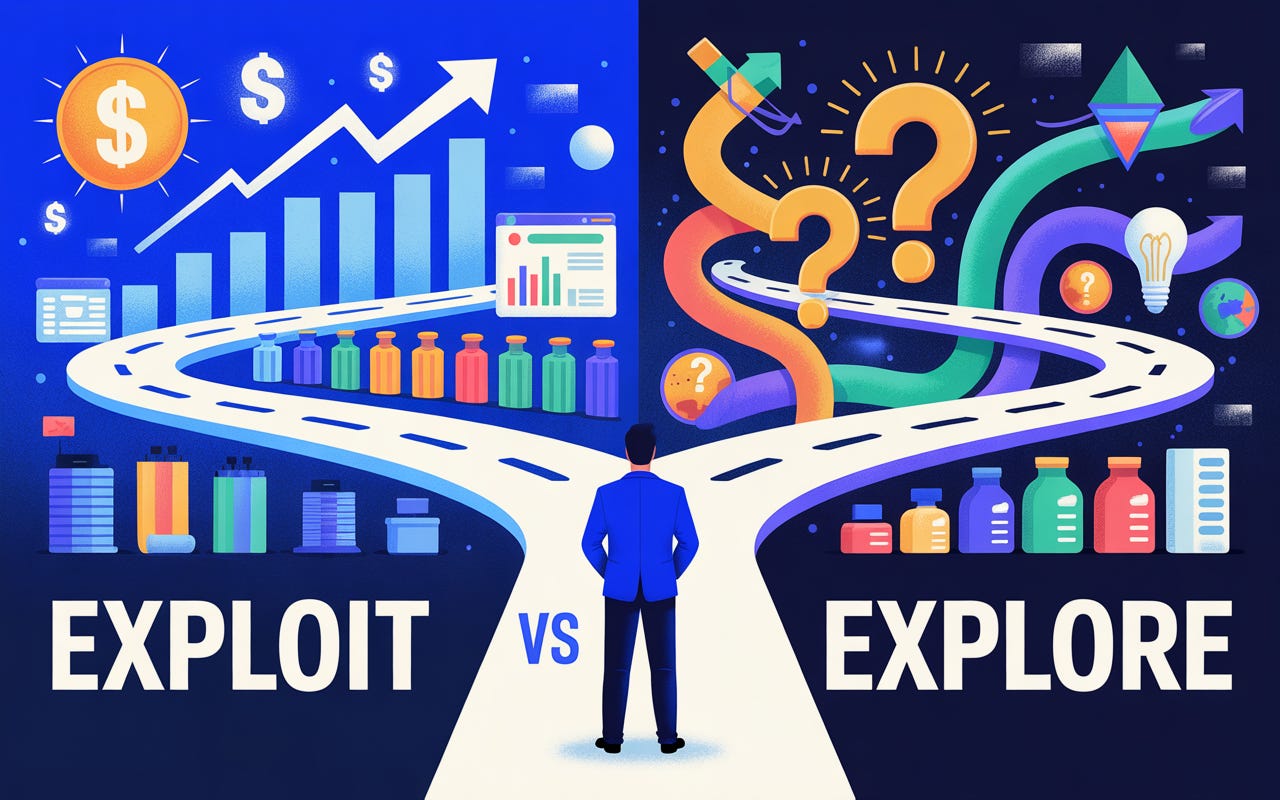
What is the exploit vs explore dilemma?
It doesn’t show up in dashboards and it’s not a metric in your weekly report.
It rarely gets written into the annual strategy deck.
But it drives almost every decision you make. This concept comes from decision theory and reinforcement learning, but it’s deeply human.
It’s the exploit vs explore dilemma.
And if you don’t manage it intentionally, it will manage you.
In simple terms:
Exploit = Double down on what already works
Explore = Invest in discovering something new
Imagine a restaurant you love. You know your usual order is good (exploit).
But there’s a new dish on the menu that might be better (explore).
Order your usual?
Or risk disappointment for potential upside?
Now replace “restaurant” with:
Paid media channels
Does Claude write better than ChatGPT?
What’s our champion email CTA?
Product recommendations
Creative strategies
Targeting rules
Entire GTM approaches
This is marketing!
Marketing is usually all about “exploit”
Most marketing organisations are structurally biased toward exploitation. Why?
Because exploitation is measurable. Predictable. Defensible in front of a CFO.
If Meta ads are driving conversions at £X CPA, you scale them.
If Segment A has the highest propensity score, you message them harder.
If Campaign B drove 12% uplift last quarter, you repeat it.
This makes sense. But here’s the catch:
If you only exploit, your growth ceiling becomes your past performance.
You optimise yesterday’s winners… forever. And over time:
Audiences fatigue
Channels saturate
Creative performance declines
Marginal returns shrink
You don’t notice it at first. But suddenly you’re “working harder” for the same results.
Gets worse when pressure from competitors ramps up too.
Exploration feels expensive (because it is)
Exploration means:
Testing new creative directions
Trying new audiences
Entering new channels
Adjusting pricing structures
Rebuilding journeys
Letting a model test outside its top-ranked segment
And exploration has a brutal property: it often looks worse before it looks better.
Your CTR drops.
Your CPA spikes.
Your conversion rate dips.
In quarterly reporting cycles, exploration is uncomfortable. Which is why most teams underinvest in it.
Where data science enters the picture
This is not just a cultural problem. It’s a modeling problem.
Modern marketing systems - especially ML-driven ones - are naturally exploitative.
Take a recommendation engine:
If Product A converts best, the model shows Product A more often.
It learns from clicks.
Clicks reinforce Product A.
Product A dominates exposure.
Eventually, the system collapses into showing the same thing over and over. You all have this experience of “ads”. Short-term performance is maximised. But you’ve lost discovery.
In reinforcement learning, this is a classic issue. Without intentional exploration, the system never learns about alternatives.
Marketers face the same thing.
The subtle ways marketers accidentally over-exploit
Here are some common examples:
1. High-propensity bias
You only target customers with a top-X decile propensity score.
Sounds smart. But what if you are reinforcing the past?
Medium propensity customers have higher long-term value?
Low propensity customers respond differently to new creative?
Your model is biased by historical campaign exposure?
2. Channel addiction
You keep pouring budget into the best-performing channel.
But performance is strong because:
It’s harvesting intent created elsewhere
It’s benefiting from brand equity
It’s last-click attributed (lots of skeletons buried in this closet)
Exploration here might mean:
Testing incrementality
Funding awareness experiments
Testing non-performance channels
Uncomfortable. Necessary if you want to understand what’s really going on.
3. Creative Conservatism
You repeat the winning creative formula.
It worked once. Then twice. Then for a whole year.
Until it doesn’t anymore. Exploration means risking brand discomfort.
A question for marketers
Not:
“What’s performing best?”
But:
“How much of our effort should go to exploitation vs exploration?”
It’s a portfolio decision. Think of it like asset allocation. You wouldn’t put 100% of your retirement savings into one stock even if it had performed well historically.
Yet many marketing teams effectively do this.
A practical framework for marketers
Here’s a simple way to think about it:
70% Exploit
Scale what’s proven.
Optimise within established workflows.
Fund the dependable revenue engine.
20% Explore adjacent
Test new audiences within current channels.
Try new creative formats.
Expand segments slightly beyond the core.
10% Explore wild
New channels.
New positioning.
New journey types.
New product structures.
Will some fail? Yes. That’s the point.
Data science can make exploration smarter
This isn’t about blind risk-taking, you can stack the chips in your favour with structured exploration. Data science helps by:
Designing controlled experiments
Measuring incrementality
Running multi-armed bandits with exploration parameters
Monitoring fatigue curves
Identifying diminishing returns
Simulating long-term value, not just short-term lift
The key is that this is all intentional - exploration shouldn’t be accidental, it should be engineered.
The psychological barrier
Exploration threatens certainty. I get it. It makes performance marketing uncomfortable. It introduces variance, and its a bit scary.
But here’s the paradox:
The companies that dominate long-term are those that make exploration systematic.
Don’t blindly believe what John says, look at the list of brand you admire: Amazon. Netflix. Spotify.
Their algorithms don’t just exploit top performers. They inject novelty on purpose, because they understand that if you don’t explore, you stagnate.
The takeaway
Next time you look at your plan, ask:
Where are we over-exploiting?
Where are we intentionally exploring?
Is our modelling reinforcing the past?
Are we measuring long-term value or just short-term lift?
And most importantly:
Are we comfortable enough with experimentation to tolerate short-term noise in exchange for long-term learning?
It’s about discovering what works next.
Video: MLs like teen spirit poddy
In this episode, Jared, a PhD researcher in econometrics and causal inference, talks about synthetic control methods (SCM) and why they are increasingly valuable for marketing analytics. Jared explains synthetic control as a way of estimating counterfactuals when experiments aren’t possible. The discussion explores practical marketing use cases including geo-based ad testing, retail store layout changes, website interventions, and campaign measurement when experimentation is messy or incomplete. The conversation closes with a clear-eyed discussion of the SCM limitations.
Thank you for the support folks!
Cheers,
John
PS - There is another way I might be able to help you:
MLs like teen spirit is our sister podcast show - I cover all manner of Data Science topics here, often with a marketing orientation.